IT Track
International Speaker:
Dr. Salil Kanhere
University of New South
National Speaker:
Dr. Pawan Goyal
Indian Institute of Technology Kharagpur, India
DC Track
International Speaker:
Dr. Sandeep Kulkarni
Michigan State University, USA
National Speaker:
Dr. Yogesh Simmahan
Indian Institute of Science, India
AI4Sc Track
International Speaker:
Swati Biswas
University of Texas at Dallas, USA
National Speaker:
U Deva Priyakumar
International Institute of Information Technology Hyderabad, India
DC TRACK
International Speaker:
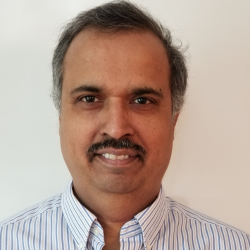
Dr. Sandeep Kulkarni
Michigan State University, USA
Title: Asynchronous Algorithms
National Speaker:
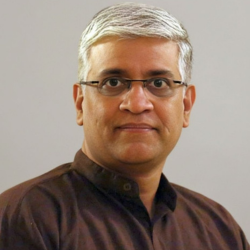
Dr. Yogesh Simmahan
Indian Institute of Science, India
Title: Distributed Intelligence on Dynamic Graphs: Partitioning, Mining and Learning at Scale
IT TRACK
International Speaker:
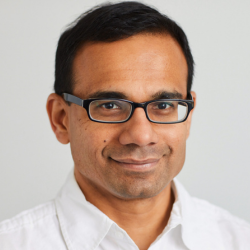
Dr. Salil Kanhere
University of New South
Title: Cracking the Code: Detecting the Next Generation of Social Bots
National Speaker:
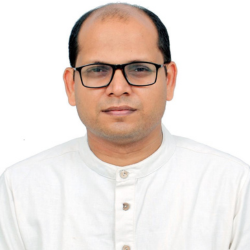
Dr. Pawan Goyal
Indian Institute of Technology Kharagpur, India
Title: Sanskrit and Computational Linguistics: Analysis and Generation of Sanskrit verses
Next, recent works that leverage the latest advances in deep learning for Sanskrit NLP will be discussed, along with interesting future directions in Sanskrit Computational Linguistics. One interesting work to be discussed addresses the question: Can LLMs be adapted for structured poetic generation in a low-resource, morphologically rich language such as Sanskrit? Current progress will be described, including the introduction of a dataset designed for the translation of English prose into structured Sanskrit verse, with strict adherence to classical metrical patterns, particularly the Anuṣṭubh meter. A range of generative models—both open-source and proprietary—are evaluated under multiple settings. Specifically, constrained decoding strategies and instruction-based fine-tuning tailored to metrical and semantic fidelity are explored. Using the proposed decoding approach, over 99% accuracy is achieved in producing syntactically valid poetic forms, and general-purpose models are substantially outperformed in terms of meter conformity. Meanwhile, instruction-tuned variants are shown to exhibit improved alignment with source meaning and poetic style, as indicated by human assessments, albeit at the cost of marginal trade-offs in metrical precision
Dr. Goyal has been the recipient of several notable honors, including the 2020 INAE Young Engineer Award, the Google India AI/ML Research Award 2020, and the Facebook AI and Ethics Research Award 2019. He was also honored with the Faculty Excellence Award from IIT Kharagpur in 2022 and the ACM HyperText Ted Nelson Newcomer Award in 2021. Prior to joining IIT Kharagpur in 2013, he served as a post-doctoral fellow at INRIA Paris-Rocquencourt, where he contributed to the Sanskrit Heritage Site.
Throughout his career, Dr. Goyal has led numerous high-impact sponsored research projects funded by agencies such as MeitY, Microsoft India, and the I-Hub Foundation for Cobotics, focusing on areas like Large Language Models (LLMs) for legal assistance, multilingual dialogue systems, and goal-oriented healthcare interactions. He is also a dedicated educator, having developed popular NPTEL courses on Natural Language Processing and Deep Learning, and has supervised a wide range of doctoral and master’s theses. His academic journey includes a B.Tech. in Electrical Engineering from IIT Kanpur and a Ph.D. from the University of Ulster, UK, where his research focused on analytic knowledge discovery for information retrieval and text summarization.
AI4SC TRACK
International Speaker:
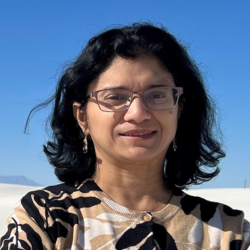
Dr. Swati Biswas
University of Texas at Dallas, USA
Title: Absolute Risk Prediction for Substance Use Disorders using Bayesian Machine Learning
Dr. Swati Biswas is a Professor of Statistics and Associate Head of the Department of Mathematical Sciences at the University of Texas (UT) at Dallas. She received her PhD from the Ohio State University and did her postdoctoral training at the UT MD Anderson Cancer Center. Her research interests are in biostatistics, in particular, statistical genetics, genetic epidemiology, cancer genetics, and risk prediction models. She has been PI on several grants from the National Institutes of Health for developing statistical methods for detecting gene-environment interactions, risk prediction for breast cancer, and meta-analysis of cancer risk conferred by genetic mutations. Several of her proposed models are currently in clinical use. More recently, she has been also developing statistical and machine learning models for risk prediction of substance use disorders. She is one of the founding members of the Texas Artificial Intelligence Research Institute at UT Dallas. She is recipient of Young Researcher Award from the International Indian Statistical Association and is an Elected Member of the International Statistical Institute.
National Speaker:
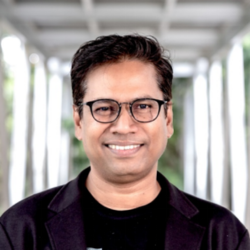
Dr. U Deva Priyakumar
Center for Computational Natural Sciences and Bio-informatics, IIIT Hyderabad, India
Title: Modern Artificial Intelligence for Drug Discovery
Deva finished his PhD from Pondicherry University/IICT Hyderabad followed by a postdoctoral fellowship at the University of Maryland. He is currently Professor and Dean (R&D) at IIIT Hyderabad. He was the founding Project Director of IHub-Data, a Technology Innovation Hub on Data Driven Technologies. His major research interests are in the areas of applying computational methods for studying chemical and biological systems/processes. Recently, his group has made significant contributions in applying modern AI/ML techniques for molecular science research. He has received Indian National Science Academy Young Scientist Medal, Young Associate Fellowship from Indian Academy of Sciences, Innovative Young Biotechnologist Award, Distinguished Lectureship Award by CSJ, JSPS Fellowship, Chemical Research Society of India Medal and Google Impact Scholar award.